A probability tells you how likely something is to happen. We use probabilities to talk about things that we are uncertain of. Such as the next card on the board in a game of poker.


Lots of probabilities

Probabilities are often expressed as percentages, from 0 to 100. An event that is completely certain to occur would have 100% probability, while something that is absolutely impossible would have zero probability.

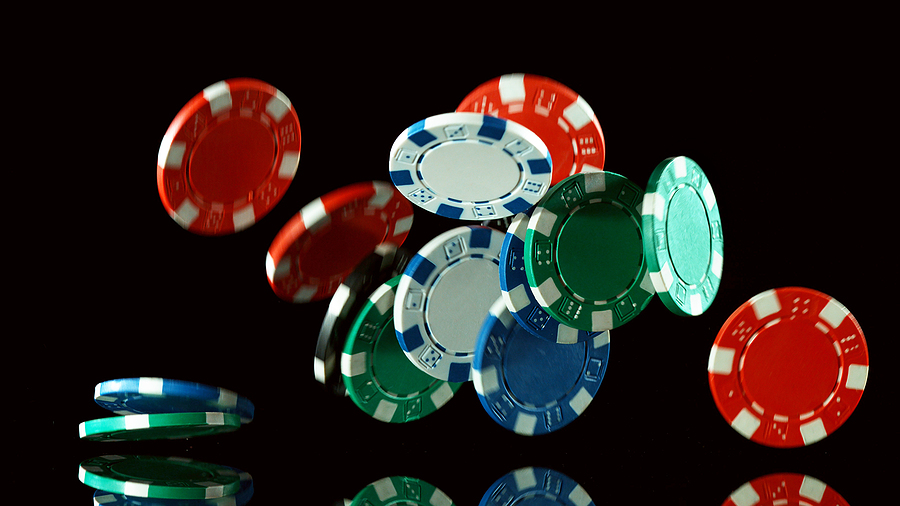
Rolling a six with a die has a probability around 17%. We'll show in another place how you can come to this conclusion. Let's just say for now that this is a basic fact that no one would argue with. (Note that this is not true for the dice in the picture above.)

Where are the probabilities?

But, you may ask, how does the die know this? When you roll a die, where is this probability to be found? Where does it reside? Is it in the die? Is it in your hand somehow? Where else could it possibly come from? Have you ever seen a probability?

Well, if there are probabilities in my hand, I certainly didn't put them there. And I'm sure no one put them in the hand of my little son, but he has the same probability of rolling a six as everyone else, even though he's only six months old.

So then, probabilities must be given to us with the genes, right? But if they are, how did evolution figure out the probabilities for rolling a die ages before man invented the die? It's truly a miracle.

Are the probabilities in the die?

If the probabilities are not in your hand, maybe they are tucked away in the die? If so, who put them there? Is it a skill that all dice makers acquire in school? Do carpenters have a special tool for this? The Probability Spatula?

Now, if you cut up a die in eight smaller dice, each one of them must inherit the same set of probabilities as the original die, right? But if you cut the die in two halves, the sides become unequal and the probabilities must change accordingly. How do you teach all these facts to the die?

Suddenly, making dice seems like the world's most complicated profession. Still, any school boy or girl can make one from a piece of wood.

It doesn't make sense!

Probabilities are about our knowledge

The truth of this giant mystery is this: Probabilities don't exist in the outer world. They're not hidden in the die, and they're not planted in our body parts.

The important lesson of this article is this: Probabilities are all in our mind.

Probabilities are our way to express how much or little we know about something. They're a measure of our uncertainty.

They're also a tool to reach rational decisions despite a lack of complete knowledge. Which is good since we almost never have complete knowledge about anything.

In this sense, probabilities are subjective. You have your view of the external world and I have mine. You have to act on what you know yourself, no other knowledge is available to you. You cannot operate with any other probabilities than your own.

On the other hand, if two rational persons have the same information about an event, their probabilities for the event will be identical. In this respect, probabilities are objective and shared from person to person.

Probabilities are both subjective and objective

The probabilistic "method" is objective, that is, how we come to a conclusion from the imperfect information we have access to. But the information to which we have access to is often subjective. It usually depends on our shifting powers of observation, it depends on where we were at a certain time, which way we turned our head, and so on.

But when it comes to poker, we all know exactly which cards are in the deck and on the board. In this case we all have the same, objective information.

If a player has two hearts in his hand and there are two hearts on the board, he has seen four hearts. There are nine hearts left unseen. The probability of making a flush can be deduced from this information alone. It doesn't depend on any subjective evaluations or superstitions.

This is why it makes sense to talk about probabilities in poker.

Plenty of probabilities in poker

There's a lot of objective information available, and we can do some really useful probabilistic calculations about what is most likely to occur in a particular situation.

Then of course, the probability that an opponent would raise it up with two pair on a two-suited flop is subjective and will vary from observer to observer, because we have different sets of information to start with.

But even in this case probability theory gives us tools to deal with the information we take in by observation. If you can process this kind of information better, you will know more than your opponents.

And in poker, knowledge is cash.

Conclusion

Probabilities are all in our mind. They refer to our knowledge of the outer world, but have no independent existence in the outer world. This doesn't prevent them from being very useful. Your probabilities are your own personal assessment of the situation and the best you can do when it comes to mastering the situation.

/Charlie River

-

This article is part of the poker math series:

  1. Basic Probability Theory
  2. Where do Probabilities Live?
  3. Average, Expected Value, Variance and More
  4. What Is Odds?
  5. What is Outs in Poker?
  6. The Math behind Calling and Folding
  7. EV - How To Calculate It
  8. Variance - How to Calculate It


Read my blog

Follow me on Twitter