Unexpected things happen in poker, we all know that. When we move in on the turn, we don't know what card will come on the river. Even if we are big favorites, once in a while we'll lose it all.
Since it's all random, right? Maybe it is, or maybe it isn't.
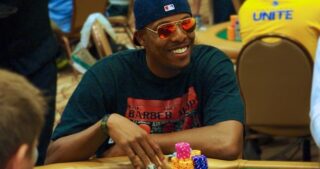
Love is all random (photo courtesy of Fran Gambín)
Experiment: non random shuffle
Imagine this experiment: I will be the dealer in a game of holdem. Between hands, instead of the regular shuffling I will arrange the cards in a predetermined order.
I will follow a complicated algorithm. Something like this:
"Take the first card. Look at it. Discard a number of cards equal to the card's face value. Look at the next card and repeat from above. When you get to the end of the deck, start over with the remaining cards until all cards have been sorted in. Go through the whole deck three times." (We'll have to make sure that the algorithm fulfills a few formal requirements.)
Not only is such an algorithm sufficiently complicated to get the cards well mixed up. More importantly: the algorithm is unknown to you.
What is more, you don't even know about the experiment. You take for granted that I do the usual, careful shuffling. (How can I perform my meticulous reordering of the cards without your noticing? Most likely because you had a few drinks.)
Uncertainty remains
Then we play. After a while you move in as an 87% favorite and lose. Is this unexpected event due to randomness?
No, in this experiment there's definitely no randomness. Everything is predetermined. You just don't know it.
What you experience is uncertainty.
It's an uncertainty caused by incomplete information. You don't know what card will come on the river.
This is what we're dealing with in poker. It's within this uncertainty that unexpected events can pop up and slap us in the face.
Whether the uncertainty is generated by true randomness or a fixed but unknown algorithm doesn't make any difference.
Randomness in poker
As a matter of fact, it's far from evident that the regular card shuffle generates randomness either.
Rather, shuffling is a way of placing cards in a complicated order that we cannot predict. Just like in the experiment.
Online poker sites use very complicated algorithms when shuffling the electronic cards. Usually they combine a host of randomized parameters to create unpredictability.
They may even bring in parameters from outside of the software, such as the white noise generated by a nearby heat source or players' mouse movements (how sick is that).
It's still debatable if what they create is true randomness or just a very high degree of unpredictability. The point is, it doesn't matter.
As long as all possible orderings of the cards are equally likely and cannot be predicted by the players, the games are fair.
So, before you go into the poker forums and blame your losses on PokerStars' random number generator, realize that it doesn't really matter, as long as you cannot predict the order of the cards.
/Charlie River
-
Comments on this Article
Alain Ellul (Nov 16, 2010)
Hi Charlie,
I don't dispute this theory however if you sit at a table competing against 8/9 other players you have never met and can't assess if they are real players like yourself or not (on online websites), you can't really prove the above...You would have 1 chance in 10 in winning and if you play hi/lo omaha it's even less...
Comment