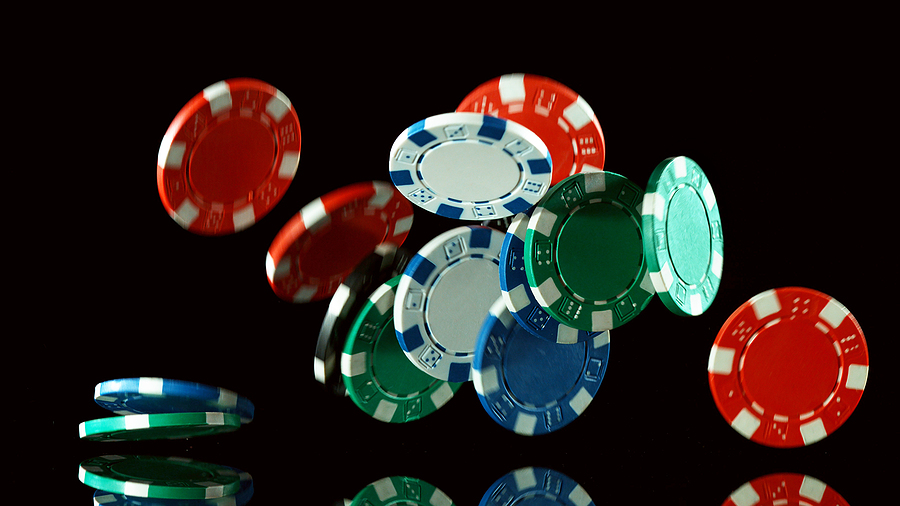
Photo courtesy of Sanja Gjenero
Anything missing in the list? Email us at info (at) pokerjunkie dot com.
Average
The value in the middle around which something varies.
If you roll a die many times, the average is the total sum divided by the number of rolls. If you play 100,000 poker hands and make a $5,000 profit, your average profit per hand is $0.05.
If you're an average online poker player, you're breaking even against the opponents but losing money due to the rake.
Bankroll requirement
A rule for the highest stakes that you can play at with a certain amount of money in your bankroll if you want to avoid going broke.
With "bankroll" is meant the amount of money that you could stand losing to the poker gods. While professional poker players may have an actual, well-defined poker account, for hobby players it's more a matter of psychological limits.
Even consistently winning players must respect the bankroll requirements or they will lose their bankroll eventually.
As a matter of fact, bankroll requirements don't even matter for losing players. They will go broke no matter what. (Unless they read up on poker strategy and become winning players.)
Combinatorics
Combinatorics is the science of combinations. It answers questions about the number of ways that things can be combined.
This kind of question comes up in many probability calculations in poker. For example, in how many ways can you deal five cards from a deck of cards? The answer is 2.6 million.
Game theory
The mathematical theory about games. It may not be as exciting as it sounds, mostly it's about things like auctions or traffic signals.
However, game theory tells us how often we should do various moves in poker games to stop opponents from exploiting our game. It predicts things such as bluffing frequency.
Equity
Your equity in a pot is the share of the pot that you're entitled to, so to speak.
If there's $100 in the pot and you have a 15% chance to win it, your equity is 15% of $100, that is, $15.
We also talk about "bluff equity", "fold equity" etc. to designate the monetary value that a certain action has to you - on average.
EV
Mathematical concept that means "expected value". It's the theoretical value of an uncertain outcome, a prediction of the average if you like.
If you flip a coin and either lose $10 or win $20, you'd expect to win $5 on each flip on average. Your EV is $5.
It's a general truth in poker and other games: if you have an expected value above zero (+EV), playing will generate a profit in the long run.
Expectation value
See EV (expected value).
Law of large numbers
This law is actually an empirical observation about repeated trials. If an event occurs many times, the average value of a certain outcome will approach its expected value (EV).
For example, if you deal two cards very many times, the share of a pair of aces will approach the expected average of 1/221.
Long term
The period of time in which natural variations even out.
According to the Law of Large Numbers, if you repeat an event many times, the average of the outcomes will approach the expected value.
The length of the long term depends on the degree of variation and how often the event occurs.
Something that varies wildly will take longer to even out. Events that are very rare will also need longer time before the average value can defeat variance.
The average starting hand you're dealt in a game of poker approaches the expected value pretty quickly, since you get one starting hand in every hand you play.
Being dealt pocket rockets happens only once in 221 hands on average, so it takes much longer for your share of pocket rockets to approach the expected 1/221 of your dealt hands.
The event of winning the WSOP Main Event will not even out in a human life time. This event happens only once a year and there are around 7,000 players, so we're talking many thousands years before a player's share of wins would approach the expected 1/7,000 (assuming the same 7,000 players played every year.)
Mean value
Mean value is the same as Average.
Odds
Odds is another way of expressing probabilities. It's often being used in poker because it fits nicely to the way probabilities appear in poker - the number of good cards compard to the number of bad cards (winning odds), and also the size of the pot compared to the bet size (pot odds).
Outs
Outs is the number of cards that will make your hand a winner. Counting outs is a basic skill for a poker player. You use it to calculate your chances of winning a hand - your Winning odds.
Pot odds
Pot odds tells you how much you can win in a hand compared to how much you have to put at risk.
Strictly speaking this is not odds, since it's not about probabilities. But that doesn't really matter, pot odds come in handy in poker.
Probability
Probability is a measure of how likely something is to happen. An event that is very likely to happen has a high probability (close to 100%) while a very unlikely event has low probability (close to zero).
Probability theory is not restricted to things that can be repeated, though. It applies just as well to things that only happen once (or never).
When the hairy guy across the table moves in his huge stack over the top of your pair of kings at the WSOP final table, it's an event that will never occur again. Still you can handle it using the usual probabilistic thinking.
Risk of ruin
The risk that you go broke due to natural variations.
For every combination of average profit, variance and bankroll, there's a certain risk that you'll lose the bankroll.
By choosing a very low risk of ruin, for example 1%, you can deduce your so called Bankroll requirements. They tell you how high you can play, given the amount of money you are willing to risk, if you want to be 99% certain of not going broke.
Spread
See Variation.
Standard deviation
Just like variance, standard deviation is a measure of variation. As a matter of fact, the standard deviation is defined as the square root of the Variance.
Statistics
Statistics is a method for collecting data and analyze them using probability theory. It's fair to say that probability theory and statistics are inseparable.
Statistics, or stats, are also the data being collected and the parameters that describe the data, such as the mean value and the variance.
Stats
Short form for statistics when referring to data about a player's game.
By studying your stats you can find areas of improvement in your game. For example, you may notice that you play too many hands or that you call to often.
Variance
The outcome of a random event is spread out around the expected value in the middle. Variance is a way to measure this variation. High variance means large variations, and vice versa.
Variation
The actual outcome of an uncertain event will vary around the expected value in the middle. Some things vary a lot, others just a little.
Even if you're a poker player who wins a certain amount per session on average, the results of individual sessions will vary around this average.
The degree of variation depends on many things, such as the game you're playing. It's often said that pot limit Omaha sessions have a greater variation than no limit holdem sessions and that, as a consequence, you need a bigger bankroll to play PLO.
Winning odds
Your winning odds is your chances of winning the hand you're in. Of course, this is normally something you cannot know for sure, but you must learn to make good estimates.
-
PS We'll provide links to further reading as more articles in the Poker Math series appear at the site.
Comments on this Article
Paul Mathers (Sep 27, 2010)
Nice work and provides a useful insight into how much of a role statistics and probability play in the game of poker. There's some great books on poker theory which I found helpful in the poker bookstore at http://www.pokersuccesguide.com and wikipedia provides quite a lot of poker terms which will help a newbie poker player.
Comment