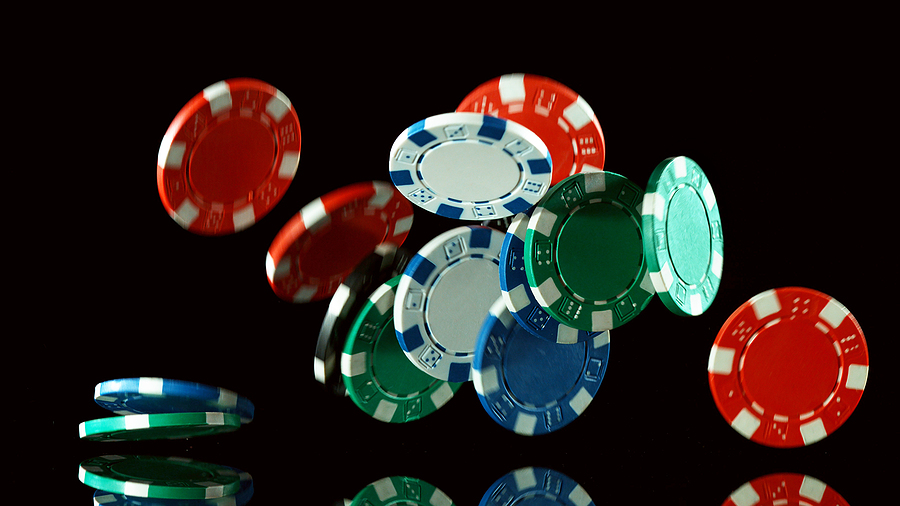
A popular pastime among poker players is to gamble it up in simple luck games, basically flipping a coin. To spice things up, it's customary to gamble for quite substantial sums of money.
It's just a friendly little game to fill out time. The idea is that gambling for big money gives you a thrill, but no one will lose much in the long run anyway since coin flips are fair. If the game got too big, the friendship would be in jeopardy.
Losses don't even out
Well, it's true that things even out over time, but in this assumption hides a potential friendship killer: What evens out are the relative frequencies.
On the contrary, actual losses add up!
If you flip a coin many times, the share of heads (or tails) will come ever closer to 50%, that's true. But the size of the game strays further and further away from zero, in a sense.
As you keep playing the fair game, big losses become more and more likely.
Natural variation is the risk
Let's say that you and a friend repeatedly flip a coin, each betting $100 on the outcome. If you flip just once, one player will lose $100. If you flip twice, you're 50/50 between a draw and one of you losing $200.
After ten coin flips, the maximum loss is $1000, of course, but this is very unlikely. With 90% certainty no one will lose more than $300. That sounds okay, doesn't it?
After 100 coin flips, the 90% interval lies between 42 and 58 wins for one of you. This means that there's a ten percent chance that one of you will lose $800 or more.
The ten percent interval stretches over larger amounts than before, and this development continues as the game moves on. The spectrum of unlikely events grows larger with every bet. The long tail gets longer.
How far do you want to go
After 1000 coin flips, the 90% interval spans from 474 to 527. There's a ten percent chance that one of you will lose $2,600 or more.
If you feel that this is an okay level of risk among friends, then game on.
Just be aware that your friendly debts are not likely to decrease by continued betting. They may decrease, but they may also grow bigger still. It's a coin flip.
/Charlie River
-
Comment